
Introduction
Email marketing returns $42 for every $1 spent — one of the highest ROI channels in digital. Most brands still focus on paid ads and ignore retention. That's where the real money is, and that's exactly what Klaviyo is built for.
Everything you need to know about Klaviyo for e-commerce — from flows and segmentation to A/B testing — and how to turn email into a consistent revenue channel for your store.
What is Klaviyo?
Klaviyo is an email and SMS marketing platform built for e-commerce. The differentiator is behavioral data: product views, cart events, orders, and inactivity all feed targeting and automation.
- Viewed a product → message can follow
- Added to cart → reminder or nudge
- Purchased → post-purchase series
- No activity → win-back path
Instead of one-size-fits-all newsletters, Klaviyo is designed so the right message reaches the right person at the right time, largely on autopilot once flows are configured.
What Klaviyo is used for
- Automated email flows (welcome, abandoned cart, post-purchase)
- Targeted campaigns using behavior and purchase history
- SMS alongside email where compliance and consent allow
- List growth via forms and popups
- Revenue attribution per message and per flow
Why e-commerce brands choose Klaviyo
1. It connects directly to your store
Shopify and other storefront integrations sync customer actions in near real time, so segments and triggers reflect what shoppers actually did—not a weekly CSV export.
2. It tracks revenue, not just opens
Opens and clicks matter, but revenue per recipient and attributed revenue from flows tell you whether the program is working. Klaviyo is built around commerce outcomes, not vanity metrics.
3. Advanced segmentation
Hyper-targeted sends typically convert better than batch blasts. Klaviyo's segment builder combines catalog, order, and engagement signals in one place.
4. It scales with you
The same concepts apply from thousands of profiles to millions: lists, consent, flows, and reporting grow with the brand without swapping platforms at each milestone.
How Klaviyo flows work
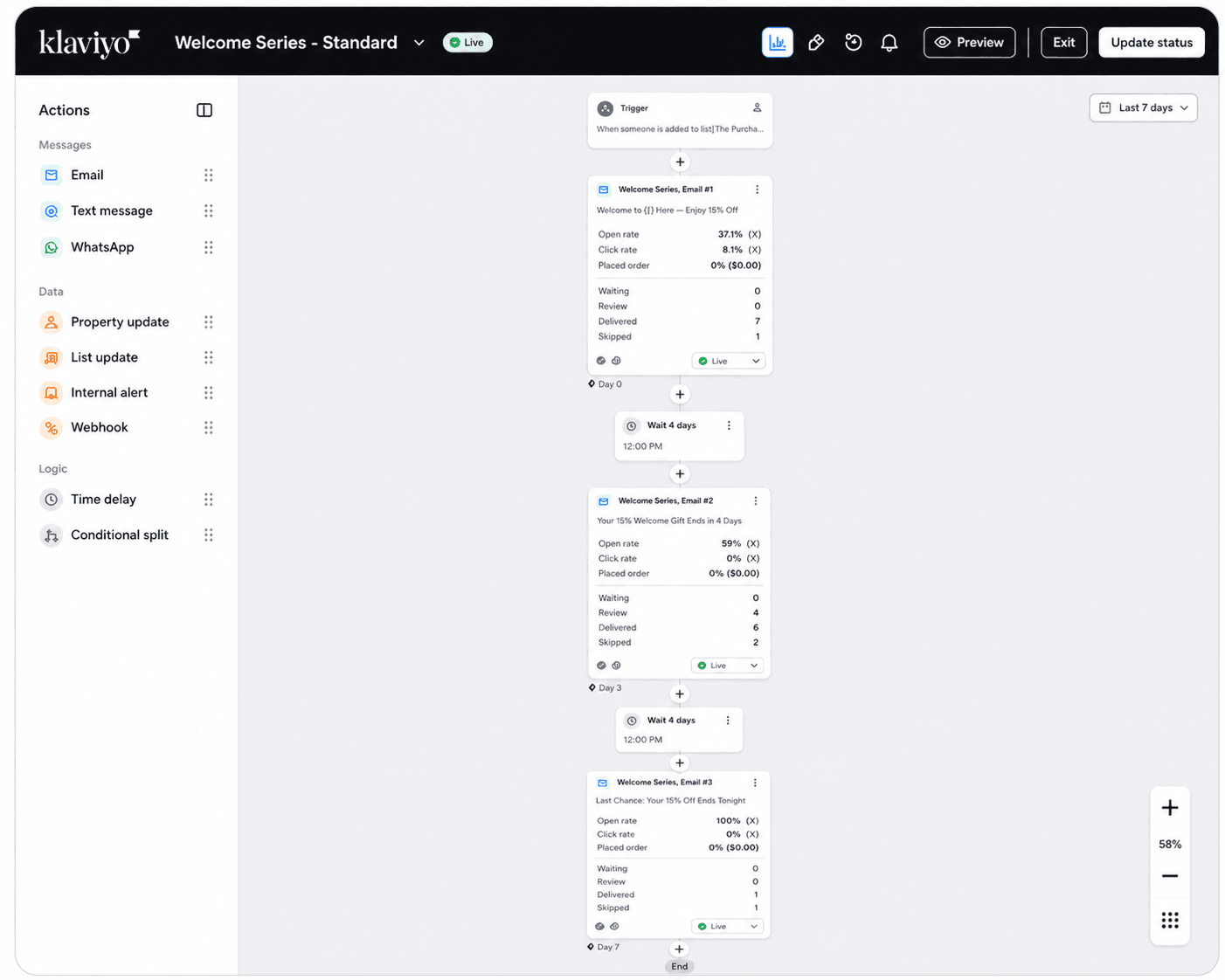
Flows are automated sequences triggered by behavior or properties. In practice, flows produce steady revenue; campaigns produce spikes. Many healthy stores see on the order of 30–50% of email revenue from flows, which is why operators prioritize flows before polishing one-off sends.
Flows generate consistent revenue. Campaigns create spikes. Build flows first, then layer campaigns for launches and promotions.
Welcome series
Onboards new subscribers and moves them from interest to first purchase. Well-built welcomes often see strong engagement; many brands see roughly 40–60% open rates on early messages when value is clear and frequency is respectful.
Abandoned cart
Recovers intent when carts are left behind—still the norm for most stores, with a large share of sessions never completing checkout. Timing, tone, and incentive strategy should match margin and brand, not copy a generic template.
Post-purchase
Drives repeat orders, reviews, and education after the sale. This is where retention economics improve without increasing ad spend.
Browse abandonment
Re-engages people who viewed a product but did not add to cart—lighter touch than abandoned cart, with proof-led follow-ups.
Win-back
Brings back lapsed buyers with clear offers or content based on purchase history—often cheaper than acquiring a new customer.
Segmentation: the growth lever
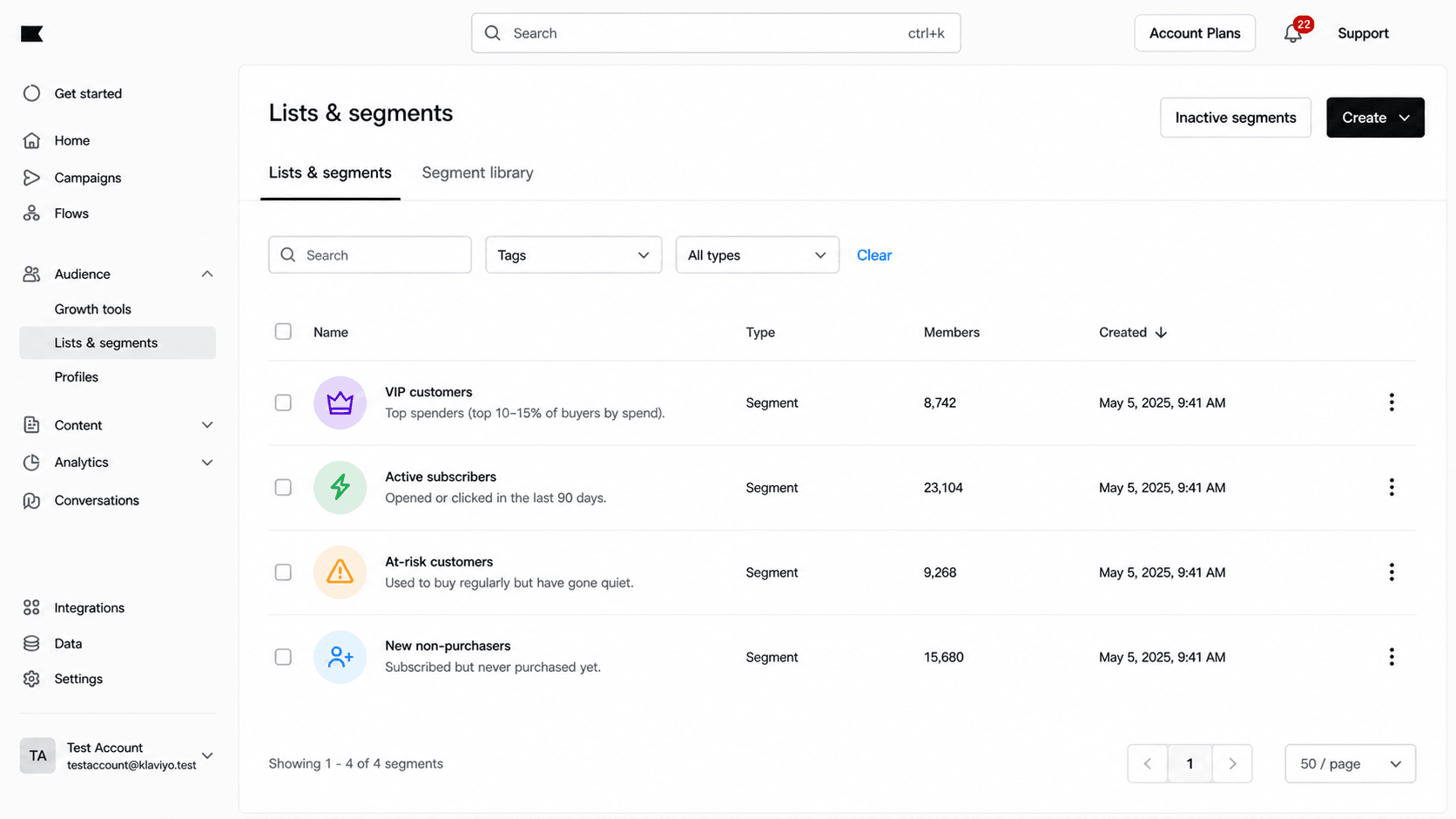
Segmentation means sending relevant messages to defined groups—not blasting the full list. Brands that segment deliberately often see roughly 20–40% higher open rates versus generic sends, alongside lower unsubscribe pressure and stronger revenue per recipient.
Core segments
A common pattern: the top 10–15% of customers contribute an outsized share of revenue—often roughly half or more. Segments should reflect that reality.
Campaigns vs flows
| Flows | Campaigns |
|---|---|
| Automated | Manual, scheduled sends |
| Steady, compounding revenue | Revenue spikes around launches and sales |
| Triggered by behavior or lifecycle events | Planned around calendar and inventory |
You need both. Flows build consistent passive revenue. Campaigns create spikes around promotions, product launches, and seasonal moments.
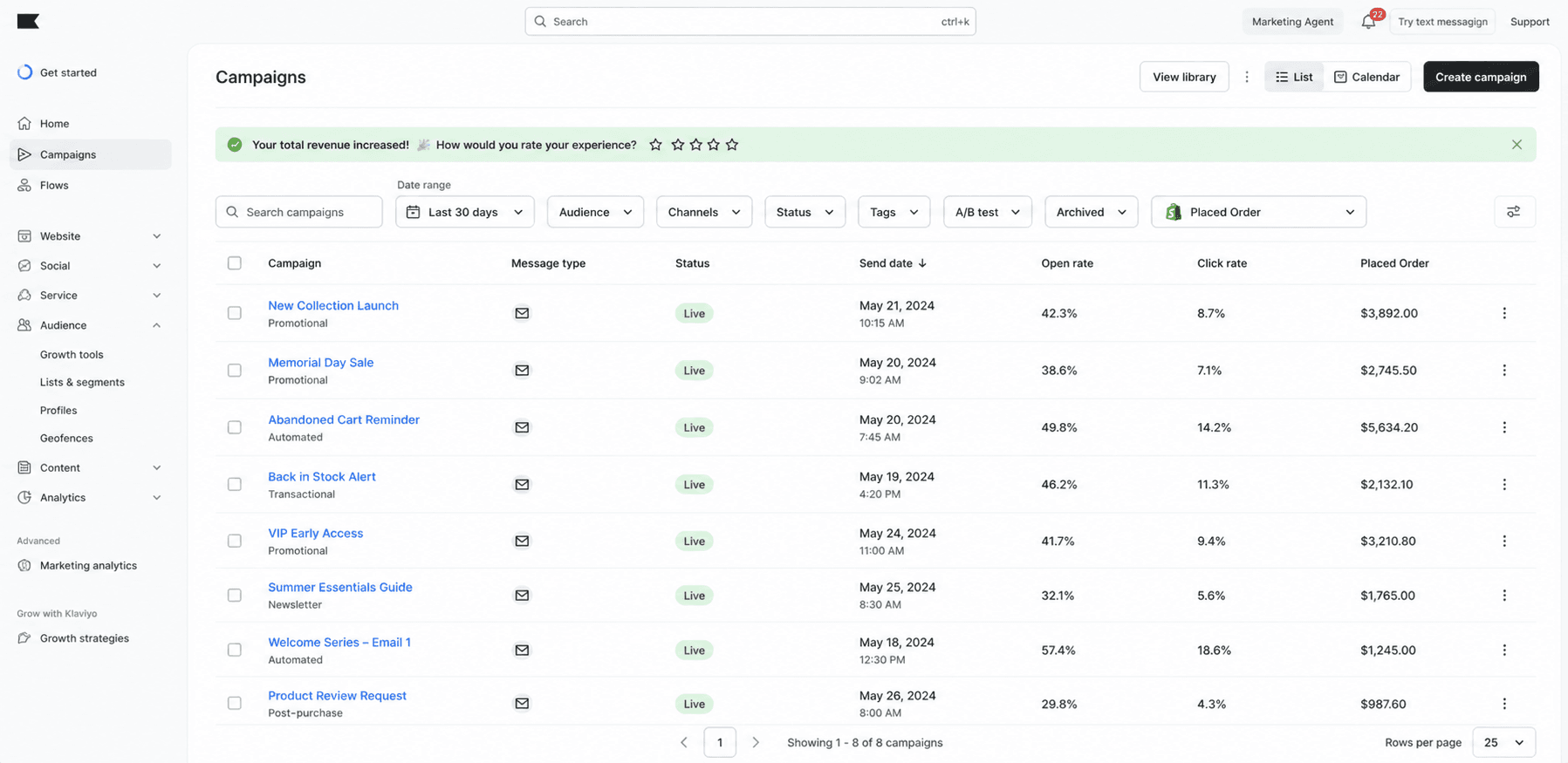
- Promotional campaigns — sales, discount codes, limited-time offers. Drive short-term spikes but use strategically; over-discounting trains shoppers to wait for sales.
- Product launch campaigns — new arrivals, restocks, seasonal collections. Send to VIPs and repeat buyers first as early access, then broaden.
- Value and newsletter campaigns — tips, how-tos, brand stories. Promotions-only lists go cold; value keeps engagement.
- Holiday and seasonal campaigns — plan list warming several weeks ahead of peak periods.
How often should you send?
- Warm, engaged list: 2–4 campaigns per week is often sustainable.
- Mixed engagement: 1–2 per week.
- Cold or unengaged list: at most about one per week until re-engagement improves.
Common mistake: blasting the whole list too often. One highly relevant send per week usually beats a daily message nobody opens.
A/B testing and analytics
Klaviyo's built-in testing and analytics tools are what separate brands that grow email revenue systematically from brands that guess and hope. Here's what to test and what to track.
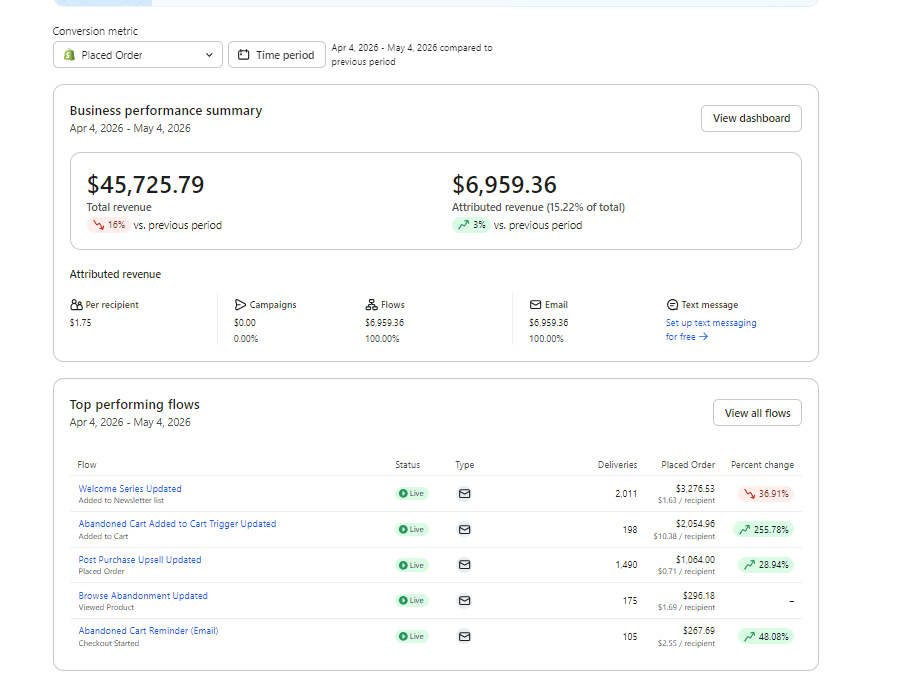
Klaviyo's analytics dashboard — see revenue, engagement, and performance across all flows and campaigns.
What to test
- Subject lines — start here. Subject lines have the biggest impact on open rates and are the fastest to test. Things to test: question vs statement, with emoji vs without, short vs long, personalised (first name) vs generic, urgency vs curiosity.
- Send time. Klaviyo's Smart Send Time feature analyses your audience's behaviour to find the best delivery window. You can also test manually — morning vs evening, weekday vs weekend. Results vary significantly by brand and audience.
- Email content. Long vs short emails, image-heavy vs text-based, single CTA vs multiple, product-focused vs story-led.
- Preview text. The line of text after your subject line in the inbox preview. Most brands ignore it — it's free open-rate real estate.
The key metrics to track every week
Keep these metrics in your dashboard weekly reviews — open and click tell you how messages perform, RPR shows commercial impact, and unsubscribe rate signals list health.
What to check on your Klaviyo dashboard weekly
- Flow revenue — growing month over month? If not, a flow needs updating
- Campaign revenue per recipient — which sends drove the most real value?
- List growth rate — adding subscribers faster than you're losing them?
- Active segment size — is your engaged audience growing or shrinking?
Who Should Use Klaviyo?
- You run an e-commerce store (Shopify, WooCommerce, etc.)
- Email is — or you want it to be — a significant revenue channel
- You have more than 500 subscribers and are growing
- You want behaviour-based automation, not just blasts
- You want to know exactly how much revenue email generates
- You're a service business or B2B company with no online store
- You need a very simple tool with minimal learning curve
- Your list is under 250 and you're in very early stages
- Budget is extremely tight at startup stage
- You won't invest time in proper setup and strategy
The honest truth: Klaviyo is only as good as the strategy and setup behind it. A Klaviyo account with no flows and no segmentation will underperform a well-configured basic tool. The platform is the infrastructure — the strategy is what generates the results.
Frequently asked questions
Conclusion
Klaviyo is powerful—but it's not the tool alone that drives results. What really makes the difference is how you use it.
Brands that see consistent growth don't rely on random campaigns or one-off emails. They build strong foundations with flows, segmentation, and continuous testing. Flows create predictable revenue, segmentation improves relevance, and campaigns amplify results at the right moments.
If your email channel isn't generating at least 20–30% of your total revenue, there's likely untapped potential. In most cases, the gap comes down to missing flows, weak segmentation, or inconsistent strategy—not the platform itself.
The opportunity is simple: Set up the right systems, focus on customer behavior, and let automation do the heavy lifting.
If you want to identify exactly where your Klaviyo setup can improve, we can help. From building high-converting flows to refining segmentation and tracking real revenue impact—we focus on what actually moves the needle.