

| Client | Rakhi By Diorin / Sanskriti By Diorin (rakhibydiorin.com) |
|---|---|
| Industry | Handcrafted Rakhis, Festive & Gifting Hampers |
| Platform | Shopify |
| Engagement | Store Rebrand (Navigation, Mega-Menu, Intent-Driven Homepage) + WeUpsell AI Recommendations across 6 placements |
Opens ChatGPT with this case study pre-loaded. No signup required on our site.
This case study covers Rakhi By Diorin, a Shopify store selling handcrafted rakhis, that needed more than a new coat of paint. The products and the customer base were both strong. The store structure was not built for what the brand was becoming.
We rebranded the store's navigation and homepage, then added WeUpsell's AI recommendations across key conversion points. Over the following two months, the store recorded ₹12.29L in AI-influenced revenue — revenue attributed to shopper interactions with WeUpsell's recommendation widgets during that period, on top of whatever the store earned outside those interactions.
The Challenge
Rakhi By Diorin sold rakhis to a base of 15,000+ customers, across its own site and through Flipkart, Amazon, and Myntra. But the brand was expanding — from rakhis alone into a wider festive and gifting range, including a Ganesh Chaturthi collection and gifting hampers. As the store moves into other festive seasons, it also appears on-site as Sanskriti By Diorin, reflecting that broader range beyond Raksha Bandhan.
The old store structure could not carry that expansion:
- Flat category lists fail at scale. A flat category list works for one occasion. It breaks down once a store spans multiple festivals, gift types, and price points at the same time.
- Missed cross-sell opportunities. Customers were checking out with a single rakhi, missing the combo, gift add-on, or sweets that usually complete a Raksha Bandhan order.
- Structural friction over superficial aesthetics. A store redesign only pays off if it fixes that gap. A new look on the same weak structure would not have solved it.
What We Rebranded on Shopify
The scope was a full navigation and homepage rebrand, not a light refresh:
- Mega-menu navigation grouped by recipient, product type, and occasion
- Homepage sequence redesigned around shopper intent, not just merchandising
- Shoppable video added to the homepage for product context
- Clean data structure clean enough for an AI recommendation engine to learn from
| Before | After |
|---|---|
| Flat category navigation | Mega-menu grouped by recipient, type, and occasion |
| Single-purpose homepage | Homepage sequenced by shopper intent (festival → gifting → bestsellers → trust signals) |
| Static product photography only | Shoppable video added for product context |
| No systematic cross-sell | AI recommendations across 6 placements |
| Single-item checkouts | Combo, gifting, and add-on visibility at the point of decision |
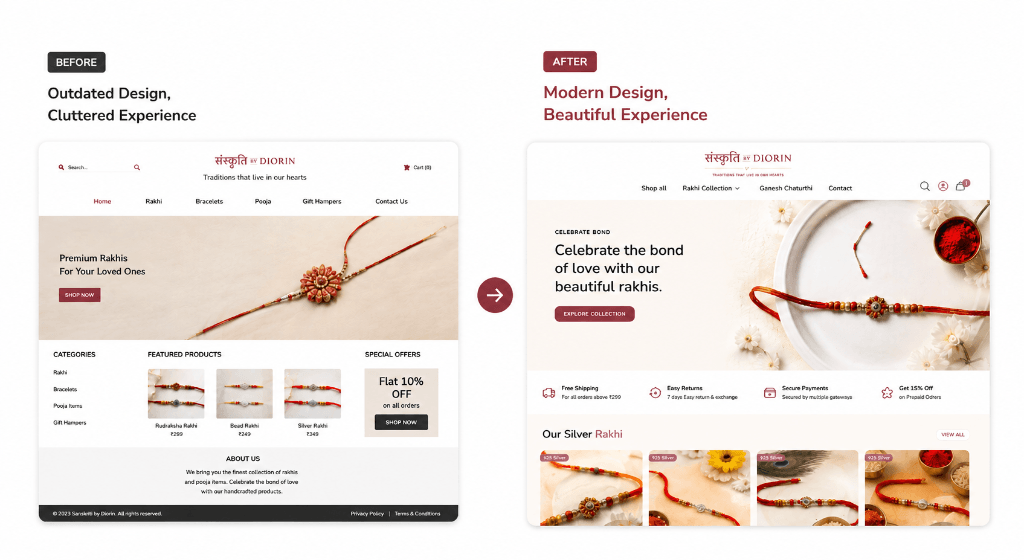
Catalogue and Navigation
The mega-menu now groups products three ways at once:
- By recipient: Brother, Sister, Bhai-Bhabhi
- By type: Silver, Combo, Kids, Bracelet
- By occasion: Ganesh Chaturthi, Gifting Hampers
A shopper can enter the catalogue from whichever angle matches their intent, instead of searching through one flat list.
The homepage follows the same logic. It moves from the current festival push, into gifting, into bestsellers, into a trust-signal section (15,000+ customers, handcrafted quality, fast shipping, easy returns). Each section does a different job in the decision, rather than repeating the same product grid.
Adding WeUpsell
A well-organized store gets the right shopper to the right first product. It does not automatically turn that visit into a bigger order. That is the gap WeUpsell was brought in to close.
WeUpsell's AI recommendation engine was added across the product page, cart drawer, order status page, post-purchase, popup, and thank-you page. It learns from actual purchase behavior, so a shopper browsing Ganesh Chaturthi items sees different recommendations than one browsing Silver Rakhis, without anyone building that logic by hand.
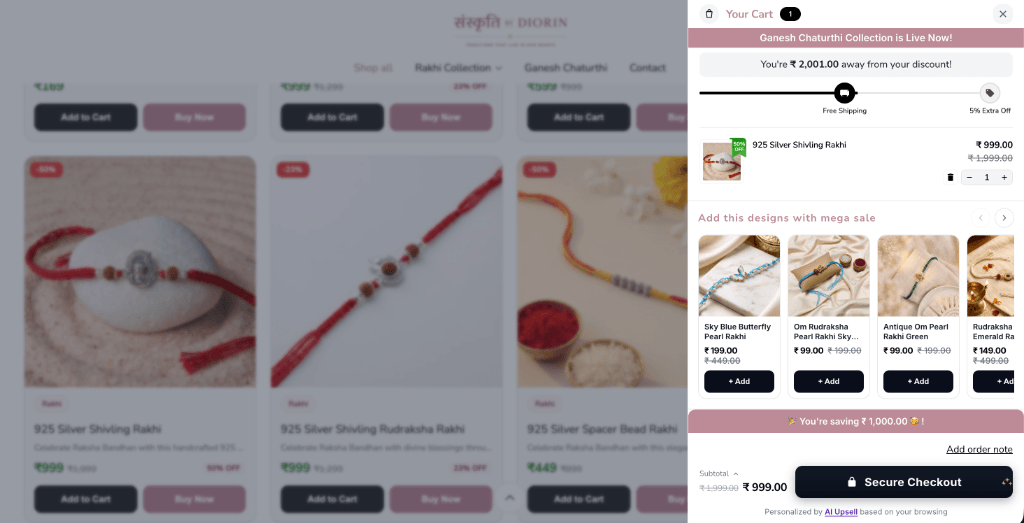
Results After Launch
Across the two months following the rebrand (Jul 1 – Aug 27, 2026):
Placement Performance Breakdown (₹12.18L Accounted)
Driven by the highest traffic volume of any placement across product detail pages.
The most efficient placement at an exceptional 11.85% conversion rate.
Delivered high-value conversions from a targeted, high-intent shopper audience.
Converting at 1.65% — capturing additional post-checkout momentum.
Four placements accounted for approximately ₹12.18L of the total. The remaining roughly ₹10.7K in the account total is not broken out by these four placements in the dashboard summary and is not attributed further here.
Future Growth Opportunity
Post-Purchase and Thank You Page offers generated close to nothing this cycle. That is the clearest untapped opportunity for next festive season.
Takeaways for Shopify Stores
If you run a Shopify store with a growing catalogue:
Frequently Asked Questions
Is your Shopify store ready to convert more of the traffic you're already getting?
See how a better storefront structure and AI-powered recommendations can work together to increase product discovery, upsells, and revenue.